Everyone tells you to find your passion. The Bhagavad Gītā puts a different question in front of a man who cannot act at all — not what do you want, but which course is actually better. This episode reads chapter 3, verse 35 with the line that usually gets cut off, and sets it next to what the research on interest and work actually shows.
In this video
- The question you can’t answer
- The man who put the bow down
- The answer, up front
- Krishna’s first move doesn’t work
- The part the self-help version drops
- Ancient Answers
Try this
In the video’s own words:
So here’s the answer up front, before I complicate it. Chapter three, verse thirty-five: better your own dharma done badly than someone else’s done well. Barbara Stoler Miller’s 1986 translation reads, your own duty done imperfectly is better than another man’s done well. Not more enjoyable, not more authentic — better. And I’ll state the limit here rather than bury it at the end: nobody has tested that verse against anything, I found no good evidence that anyone has tried, and it would be hard to design the study.
So what survives, and I want to be clear this is a modern reading rather than what the text meant. What survives is the structure. The criterion for what to do next isn’t excitement and isn’t discovery — it’s fit with what is already in front of you and already yours to handle. Chapter eighteen, verse forty-eight says it flatly: don’t abandon the work you were born to even though it’s flawed, because every undertaking is covered by fault the way fire is covered by smoke.
So here is the smallest version that fits a working day. Ten minutes, once, this week: take the work already in front of you and write down the three tasks you would still do if nobody ever noticed you’d done them. That’s the fruits clause, made testable. Then put those three first for four weeks — not because they’re your passion, but because they’re yours. Ten minutes to write it, four weeks to run it, and no career change required.
Sources
Bhagavad Gītā 1.47, 2.7, 2.11, 2.22, 2.47, 3.35 and 18.48; Barbara Stoler Miller’s translation (1986) and R.C. Zaehner’s commentary (1969); O’Keefe, Dweck and Walton (2018), Wrzesniewski and colleagues (1997), Vallerand and colleagues (2003), and Sisk and colleagues (2018).
Full transcript
The question you can’t answer
You’ve been asked what you’re passionate about since you were fifteen. You still don’t have a good answer, and you think that’s your fault. It isn’t. There’s a text that treats that exact question as the wrong one — not hard, wrong — and it says so to a man who has frozen on a battlefield. This is Ancient Answers, where a modern complaint goes looking for an older diagnosis.
Here’s what I’m not going to say. I’m not going to tell you the Bhagavad Gītā anticipated modern career psychology, because it didn’t, and that claim would be worthless to you anyway. What I found is narrower. The Gītā and about twenty-five years of research on interest and work both reject the same premise, from opposite directions — the premise that somewhere out there is a thing that is yours, already formed, and your only job is to locate it before you run out of time.
And here’s the loop I’ll close before the end. The verse everybody quotes for this doesn’t end where the quote ends. There’s one more line attached to it, it’s harsh, and it changes what the advice is for. I’ll give you the verse first, then the line nobody prints, then what I think is honestly left standing once you’ve seen both. Nothing gets softened on the way through.
The man who put the bow down
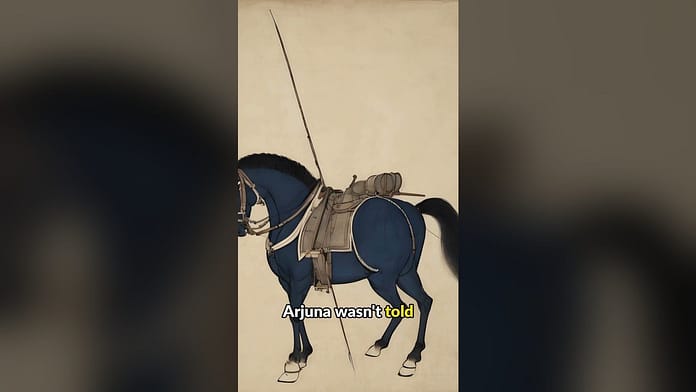
The Gītā is seven hundred verses sitting inside the Mahābhārata, composed somewhere between the second century BCE and the second century CE — that’s a wide window, the scholarship doesn’t agree on tighter, and nothing here depends on it. The scene is two armies drawn up and waiting. Arjuna is a professional soldier. He looks across at the other side, sees his cousins and his teachers and his grandfather, and in the first chapter he sits down in the chariot and lets the bow go.
Then he does the thing that matters more than dropping the bow. In chapter two he says his mind is confused about dharma — a word covering duty, law and the right thing to do, all at once — and he asks to be told, for certain, which course is śreyas: better, more beneficial. He is not asking what he wants. He’s asking which action is actually right, which is a different question from yours and a much harder one to dodge.
The answer, up front
So here’s the answer up front, before I complicate it. Chapter three, verse thirty-five: better your own dharma done badly than someone else’s done well. Barbara Stoler Miller’s 1986 translation reads, your own duty done imperfectly is better than another man’s done well. Not more enjoyable, not more authentic — better. And I’ll state the limit here rather than bury it at the end: nobody has tested that verse against anything, I found no good evidence that anyone has tried, and it would be hard to design the study.
Krishna’s first move doesn’t work
Krishna’s first move is not comfort. He tells Arjuna he’s grieving over what doesn’t warrant grief while talking like a wise man, which is close to an insult. Then comes the metaphysics — the self isn’t killed, worn-out bodies get changed the way you change clothes. And it doesn’t work; we know it doesn’t work, because there are sixteen more chapters after that one and Arjuna keeps interrupting to ask again. The text is honest about its first attempt failing.
The second move is the famous one. Chapter two, verse forty-seven: you have a claim on the action, never on its fruits. Read as career advice that sounds like giving up, and it isn’t — it’s a scoping instruction. It says the part you can actually steer by is the doing. Recognition, money, whether the thing turns out to have been your calling: all outcome, all outside the loop, none of it available as an input when you’re deciding what to do on Monday.
Now the research, because the same premise gets attacked from the other end. In 2018 Paul O’Keefe, Carol Dweck and Gregory Walton looked at people who believe interests are found rather than built. Those people were less open to material outside the interest they’d already declared. And when the thing they had declared got difficult, their interest fell further than everybody else’s. The belief that passion is discovered is what made them quit the thing they’d discovered.
There’s a companion finding from 1997 I like even more. Amy Wrzesniewski and colleagues asked people whether their work was a job, a career or a calling, and got roughly a third in each. The part that matters is what happened inside a single job title — same duties, same pay, same desk — where all three orientations turned up anyway. Calling wasn’t a property of the work. It was a property of the relationship to it, which means the search was always in the wrong place.
One more, and it grades the rest. Robert Vallerand’s group splits harmonious passion, where the activity sits inside a life, from obsessive passion, where the activity runs the person. Same intensity, opposite outcomes. So even where passion is real and measurable, its value depends on how it’s held rather than on having found the right object to hold. That’s compatible with what chapter two says about fruits, arrived at from somewhere completely different — compatible, not predicted.
The part the self-help version drops
Here’s the line I promised. Three thirty-five doesn’t stop where the quote stops. It carries on: better to die in your own dharma, another’s dharma brings danger. That’s not a nudge toward authenticity, and in the text’s own world sva-dharma isn’t a personal calling at all — it’s the duty attached to your varṇa, the social position you’re born into. Arjuna fights because he’s a kṣatriya, a member of the warrior class, not because fighting expresses who he really is.
R.C. Zaehner’s 1969 commentary reads it exactly that way and doesn’t soften it. Most popular translations keep the word dharma or render it as duty, and the English does the hiding for them, because duty in English sounds like something you signed up for. Some translators leave the word untranslated on purpose, because no single English word carries it. I’m not going to pretend that layer isn’t there. It is there, and I’d rather show it to you than quote around it.
And the research has its own soft spot, so let me grade it honestly. The implicit-theories work sits inside the wider mindset literature, and that literature has had a hard time replicating — Sisk and colleagues’ meta-analyses in 2018 found effects much smaller than the popular version implies. The interest result hasn’t been through that mill yet. So what we’ve actually got is one text whose context most people strip out, and one finding nobody has stress-tested. That’s thinner than I’d like, and it’s what there is.
So what survives, and I want to be clear this is a modern reading rather than what the text meant. What survives is the structure. The criterion for what to do next isn’t excitement and isn’t discovery — it’s fit with what is already in front of you and already yours to handle. Chapter eighteen, verse forty-eight says it flatly: don’t abandon the work you were born to even though it’s flawed, because every undertaking is covered by fault the way fire is covered by smoke.
So here is the smallest version that fits a working day. Ten minutes, once, this week: take the work already in front of you and write down the three tasks you would still do if nobody ever noticed you’d done them. That’s the fruits clause, made testable. Then put those three first for four weeks — not because they’re your passion, but because they’re yours. Ten minutes to write it, four weeks to run it, and no career change required.
Ancient Answers
That was Ancient Answers, where a modern complaint gets taken to an older diagnosis and graded on the way there. If that’s the kind of thing you want turning up every week, subscribe — it’s the segment that’s worth having, not any one topic.
Watch more on YouTube: @chittalab.
Narration and illustrations are AI-generated. Every claim is sourced above.