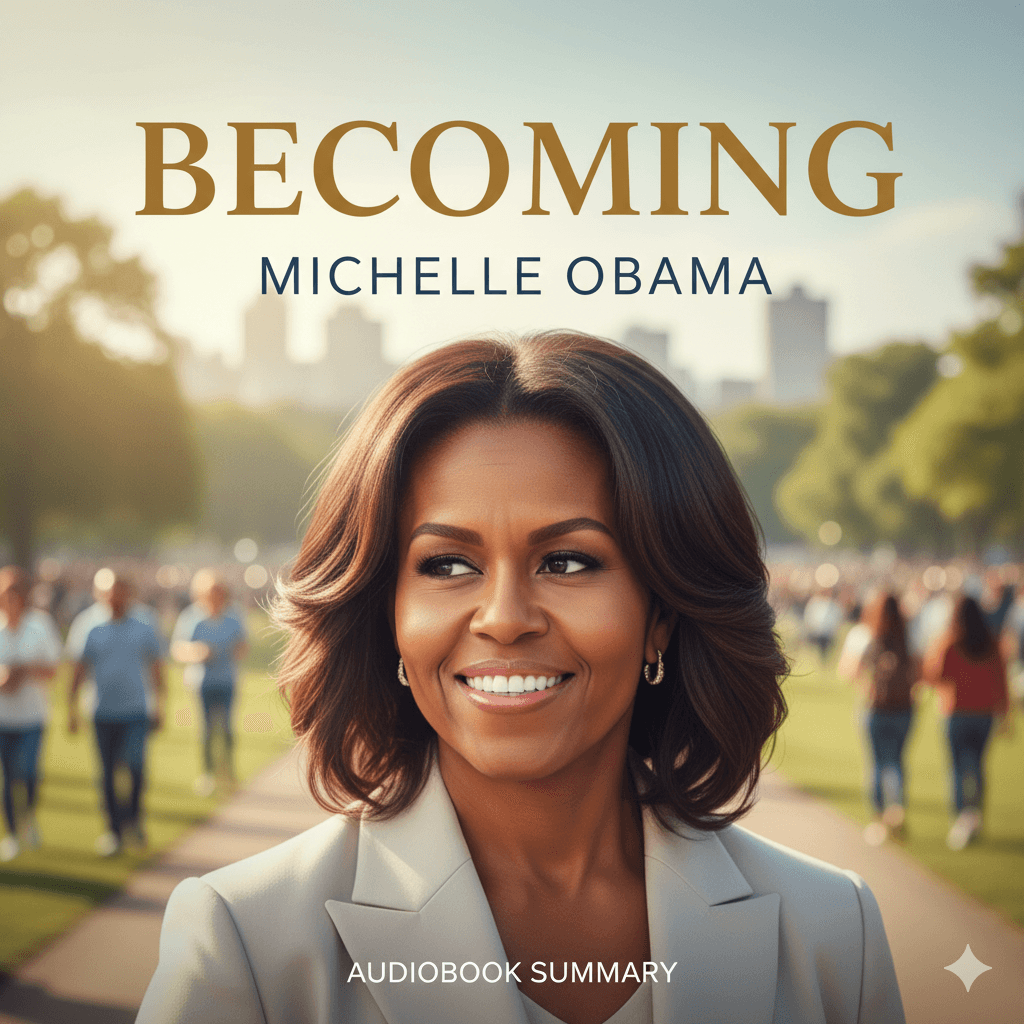
The Surprising Truths Hiding in Michelle Obama’s ‘Becoming’
To the world, Michelle Obama arrived on the public stage as a portrait of confidence and grace. As a lawyer, hospital executive, and eventually as the First Lady of the United States, her story seemed to be one of seamless ascent. We saw the poised public figure, the devoted mother, and the powerful advocate. But what was the journey really like behind the polished exterior? What were the internal struggles and hard-won lessons that shaped the woman the world came to know?
Her memoir, Becoming, pulls back the curtain on the public persona to reveal a deeply human and relatable story. It’s a narrative defined not by an absence of fear, but by the courage to move forward in spite of it. Far from a linear path to success, her life was filled with self-doubt, pivotal swerves, and surprising truths that challenge our perception of one of the most admired women in the world.
This article explores five of the most impactful and unexpected takeaways from her story—powerful lessons about ambition, parenting, partnership, and the lifelong process of becoming who we are meant to be.
1. The Question That Drove Her: “Am I good enough?”
One of the most profound revelations in Becoming is the persistent, quiet question that followed Michelle Obama throughout her life: a deep-seated feeling of self-doubt. From her earliest days, she was driven by a need to prove her worth, a feeling that she was constantly being measured and risked being found wanting.
This theme surfaces in moments both small and large. She recounts freezing up on the word “white” during a kindergarten reading test, an early stumble that left her feeling embarrassed and determined to do better. Years later, at her first major piano recital, she was shocked to encounter a flawless baby grand after only ever practicing on her great-aunt’s broken upright. It was a moment that prefigured her later experience at Princeton, where she often felt like an outsider, like “poppy seeds in a bowl of rice,” realizing she was stepping onto a stage having only ever played an instrument with broken keys.
Such is the life of a girl who can’t stop wondering, Am I good enough? and is still trying to show herself the answer.
Coming from a woman who would become a global icon of strength and assurance, this admission is incredibly powerful. It reveals that the confidence we saw was not an innate gift, but something she was constantly building and fighting to show herself.
2. The Unconventional Wisdom of a South Side Mom
Michelle Obama credits much of her resilience to her mother, Marian Robinson, whose parenting philosophy she describes as a “kind of unflappable Zen neutrality.” Mrs. Robinson’s goal was not to shield her children from the world or overmanage their lives, but to prepare them to face it with strength and independence.
Her mother’s primary mission was to foster self-sufficiency. She trusted her children to handle their own business, offering support but rarely intervening. This approach was rooted in a simple but profound belief.
“I’m not raising babies,” she’d tell us. “I’m raising adults.”
In one of the book’s most surprising and humanizing anecdotes, she shares that her mother entertained an annual “active fantasy” of leaving her father each spring. This wasn’t born of unhappiness, but was a private ritual of re-evaluation—a moment to consider her own life and choices before recommitting to her marriage. This quiet act of self-assertion reveals the deep wisdom Marian Robinson modeled: the importance of consciously choosing your life, again and again.
3. The Myth of the Perfect Path
For years, Michelle Obama was a self-described “box checker.” She meticulously followed a prescribed path of achievement, moving from Princeton to Harvard Law before landing a high-paying, high-status job at the prestigious Chicago law firm Sidley & Austin. By all external measures, she had succeeded beyond anyone’s expectations.
The counterintuitive truth, however, was that she was miserable. Despite having checked every box on the list of success, she felt profoundly unfulfilled by her work. The life she had worked so hard to build felt hollow.
The first thing was that I hated being a lawyer. I wasn’t suited to the work. I felt empty doing it, even if I was plenty good at it. This was a distressing thing to admit, given how hard I’d worked and how in debt I was.
It took two life-altering events in the span of a single year to give her the courage to swerve. The sudden death of her close friend Suzanne at twenty-six was a visceral lesson in the finality of life and the preciousness of time. At the same time, falling in love with Barack Obama—a man guided by a powerful sense of purpose—showed her a different way to live. The source reflects on this convergence: “In the span of a year, I’d gained Barack and lost Suzanne, and the power of those two things together had left me spinning.” The stark contrast between an ending and a beginning forced her to re-evaluate everything, offering a powerful lesson on prioritizing personal meaning over external validation.
4. A Reluctant Political Partner
Given that she would become one of the most effective and beloved political figures in modern history, it is stunning to learn of her deep and abiding aversion to politics. Her journey into that world began with a similar reluctance toward the man who would lead her there. When she first met Barack Obama, she was his mentor at the law firm, had sworn off dating, and was put off by his smoking. There were no initial sparks.
After meeting Barack, her father made a characteristically amusing—and incorrect—prediction about his staying power in her life.
“Nice guy,” he said. “Too bad he won’t last.”
Even after falling in love, she consistently resisted his political ambitions. She found the world of politics “queasy” and pushed back against his run for state senate, his run for U.S. Senate, and most of all, his run for president. Her story dismantles the myth of the eagerly supportive political spouse, revealing instead a partnership where one partner had to be thoughtfully and painstakingly convinced that the sacrifice of a public life was worth it.
5. The Marriage That Required More Than Love
Becoming offers a refreshingly candid look at the challenges within the Obama marriage. The fairy-tale romance perceived by the public was, in reality, a partnership that required immense work, compromise, and at one point, professional help. The strain of Barack’s demanding political schedule, which often left her feeling like a single parent, created a knot of frustration that they struggled to loosen on their own.
Their decision to seek couples counseling led to a pivotal realization for her. In their sessions, she began to see that she had been waiting for Barack to be the sole provider of her happiness, blaming his career for her own sense of imbalance. She recognized that she had to stop collecting evidence of unfairness and instead actively build the life she wanted for herself.
It was possible that I was more in charge of my own happiness than I was allowing myself to be. This was my pivot point, my moment of self-arrest.
This honest admission provides one of the book’s most valuable insights. She learned to set her own agenda—prioritizing exercise, scheduling firm bedtimes for the girls whether Barack was home or not, and building a strong community of friends. It was by taking ownership of her own fulfillment, rather than waiting for her partner to provide it, that she found balance and strengthened their union.
The Journey Never Ends
The central theme threaded throughout the memoir is captured in its title. “Becoming” is not a destination one arrives at, but a constant, evolving process of forward motion. As she eloquently states in the book’s preface, the question we are all asked as children is misleading.
…you want to be when you grow up? As if growing up is finite. As if at some point you become something and that’s the end.
Michelle Obama’s story is a powerful testament to the idea that life is a continuous journey of growth, adaptation, and self-discovery. From the striving girl on the South Side to the reluctant First Lady finding her voice, her path was never about reaching a final, perfect state. It was about the messy, beautiful, and unending work of becoming. As you reflect on her story, perhaps it’s worth asking yourself: In your own life, who are you still becoming?