4 Shocking Truths About Investing from a 70-Year-Old Book That Will Change How You See the Market
Introduction: The Timeless Secret to Winning a Loser’s Game
The modern investing landscape is a chaotic, high-speed storm. Financial news blasts from every screen, “hot tips” promise instant riches, and online brokers urge us to trade anywhere, anytime, because “every second counts.” Wall Street has turned the stock market into a nonstop national video game, and most people are losing. We are drowning in data, but knowledge is nowhere to be found.
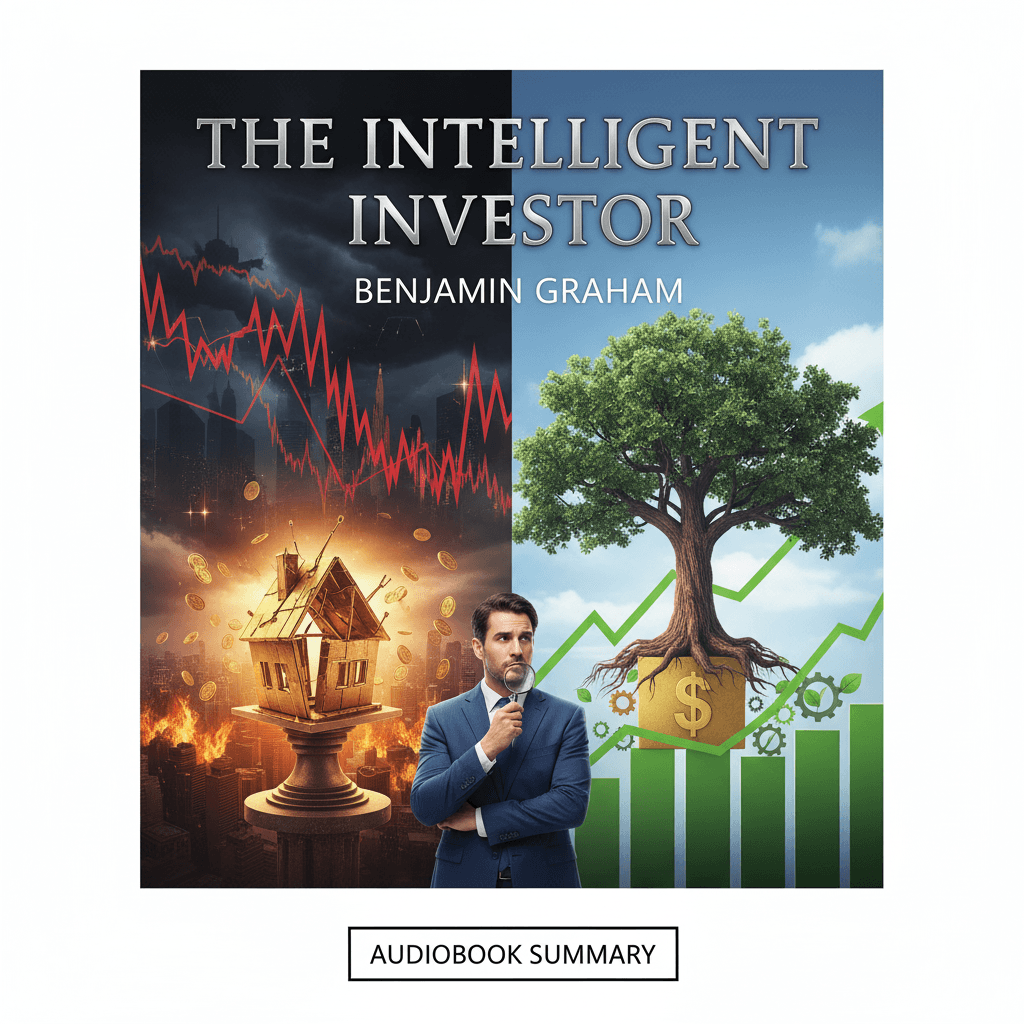
But what if the secret to winning this game was written over 70 years ago? In 1949, the legendary investor Benjamin Graham published The Intelligent Investor, a book of practical counsel that remains profoundly relevant. Its wisdom is so enduring that Warren E. Buffett, Graham’s most famous student, calls it “by far the best book about investing ever written.”
This post distills four of the most surprising and powerful lessons from Graham’s work. They are simple, counter-intuitive, and more critical today than ever before. Understanding them will fundamentally change how you see the market.
1. The Market Is a Manic-Depressive Business Partner
Benjamin Graham’s most brilliant metaphor, from Chapter 8 of his book, is the character of “Mr. Market.” Imagine you are partners in a private business with him. Every day, without fail, Mr. Market shows up and offers to either buy your shares or sell you his. The catch is that he is a manic-depressive. Some days, gripped by euphoria, he quotes ridiculously high prices. On other days, sunk in despair, he offers to sell you his shares for pennies on the dollar.
The core lesson is that you, the intelligent investor, are not obligated to trade with him. You are free to ignore his manic highs and his depressive lows. His mood should never dictate your actions. Better yet, you can take advantage of his folly. Graham explains the investor’s power over the market’s whims:
The true investor is in that very position when he owns a listed common stock. He can take advantage of the daily market price or leave it alone, as dictated by his own judgment and inclination. He must take cognizance of important price movements, for otherwise his judgment will have nothing to work on. … Basically, price fluctuations have only one significant meaning for the true investor. They provide him with an opportunity to buy wisely when prices fall sharply and to sell wisely when they advance a great deal.
This leads to a shocking takeaway, highlighted in Jason Zweig’s modern commentary on the book: An intelligent investor should actually welcome a bear market.
The intelligent investor dreads a bull market, since it makes stocks more costly to buy. And conversely (so long as you keep enough cash on hand to meet your spending needs), you should welcome a bear market, since it puts stocks back on sale.
This single idea—that you should welcome a falling market—is perhaps the most liberating and wealth-building concept in all of finance. It directly contradicts every instinct fueled by 24/7 financial news, which equates falling prices with failure and crisis. This mental model transforms your relationship with the market from one of fear and reaction to one of control and opportunity. Mr. Market is your servant, not your master.
But if Mr. Market’s prices are often irrational, how can an investor know when to take advantage of them? Graham’s next truth provides the critical filter: recognizing that even the best companies can be offered at the worst prices.
2. A Great Company Can Be a Terrible Investment
This paradox is one of the most crucial lessons in finance. A great business is not automatically a great investment. The quality of the company is only half of the equation; the other half is the price you pay for its stock.
Graham illustrates this with historical examples of premier growth stocks. Despite being excellent, innovative businesses, IBM lost 50% of its market price in a six-month decline during 1961–62, and Xerox saw its stock fall from 171 to 87 in 1962–63. The reason is that their popularity drove their prices to unsustainable heights. Graham explains the risk of buying popular growth stocks:
There are two catches to this simple idea. The first is that common stocks with good records and apparently good prospects sell at correspondingly high prices. The investor may be right in his judgment of their prospects and still not fare particularly well, merely because he has paid in full (and perhaps overpaid) for the expected prosperity. The second is that his judgment as to the future may prove wrong.
This principle is timeless. As Zweig’s commentary on Chapter 7 bluntly states, the lesson applies just as much to the tech darlings of the late 1990s as it did to the blue chips of the 1960s:
A great company is not a great investment if you pay too much for the stock.
This is Wall Street’s most expensive mistake: confusing the quality of a business with the quality of its stock. Graham teaches that they are two separate things, and the investor who fails to distinguish between them will inevitably pay the price for their popularity.
Because paying the right price is paramount, Graham provides a powerful, non-negotiable rule for determining what price to pay. He called it the “margin of safety,” and it is the central concept of his entire philosophy.
3. The Real Secret Is a “Margin of Safety”
If Graham’s work has a central concept, it is the “margin of safety,” which he details in Chapter 20. This is the bedrock principle of intelligent investing, and it is beautifully simple: purchase a security for significantly less than your estimate of its underlying value.
This concept shifts the investor’s focus entirely. The goal is not to chase maximum returns, but to ensure “protection against loss under all normal or reasonably likely conditions.” This margin provides a crucial buffer against errors in judgment, unforeseen events, or simple bad luck. As Warren Buffett emphasizes in his preface, Chapters 8 and 20 contain “invaluable advice” that is central to Graham’s entire framework.
If you follow the behavioral and business principles that Graham advocates—and if you pay special attention to the invaluable advice in Chapters 8 and 20—you will not get a poor result from your investments. (That represents more of an accomplishment than you might think.)
Zweig’s commentary on Chapter 20 reinforces the idea with a memorable story. When asked to sum up everything he had learned in his long career about how to get rich, the legendary financier J. K. Klingenstein of Wertheim & Co. offered two words:
“Don’t lose.”
Having a margin of safety is what separates investing from speculation. It is a disciplined framework that protects you not only from market turmoil but also from your own inevitable mistakes. It is the secret to surviving and thriving in the long run. This disciplined framework is essential, because Graham knew that the greatest threat to an investor’s portfolio isn’t a bad company or a volatile market—it’s a lack of discipline in the investor themselves.
4. Your Biggest Risk Is Staring Back at You in the Mirror
The final shocking truth is that the greatest enemy to your financial success is not a bear market, a recession, or a crooked CEO. According to both Graham and Buffett, the investor’s biggest enemy is themselves.
Buffett makes this clear in his preface, noting that success is a matter of temperament, not intellect:
To invest successfully over a lifetime does not require a stratospheric IQ, unusual business insights, or inside information. What’s needed is a sound intellectual framework for making decisions and the ability to keep emotions from corroding that framework.
Our own behavior—our greed, our fear, our impatience—is what leads to poor results. Zweig’s commentary on Chapter 6 cites a landmark study by finance professors Brad Barber and Terrance Odean, which found that the most active traders dramatically underperformed. After accounting for trading costs, the most hyperactive traders underperformed the market by an abysmal 6.4 percentage points per year, while the most patient investors managed to outperform the market by a whisker. Their key takeaway was simple: “The more you trade, the less you keep.”
The goal, therefore, is not to outsmart everyone else, but to master yourself. As Zweig powerfully concludes in his commentary on the Mr. Market chapter:
But investing isn’t about beating others at their game. It’s about controlling yourself at your own game. The challenge for the intelligent investor is not to find the stocks that will go up the most and down the least, but rather to prevent yourself from being your own worst enemy…
Mastering one’s own emotions and behavior is the final, and most difficult, step to becoming a truly intelligent investor.
Conclusion: It’s About Character, Not Brains
Ultimately, Benjamin Graham’s timeless wisdom teaches us that successful investing is a matter of discipline, patience, and character. It is not about forecasting the economy, trading frantically, or trying to outsmart the collective wisdom of the market. It’s about developing a sound intellectual framework and having the emotional fortitude to stick with it through good times and bad.
Now that you know the market is your servant and your emotions are your biggest challenge, what is the single most important change you can make to your own behavior to become a truly intelligent investor?