4 Counterintuitive Truths About Happiness from the Man Who Defined ‘Flow’
Over two thousand years ago, Aristotle concluded that more than anything else, what men and women seek is happiness. This age-old quest remains as urgent as ever. Yet we face a modern paradox: despite living in an era of unprecedented material wealth and comfort—luxuries undreamed of by Roman emperors or medieval kings—many people feel their lives are wasted, spent in a cycle of anxiety and boredom.
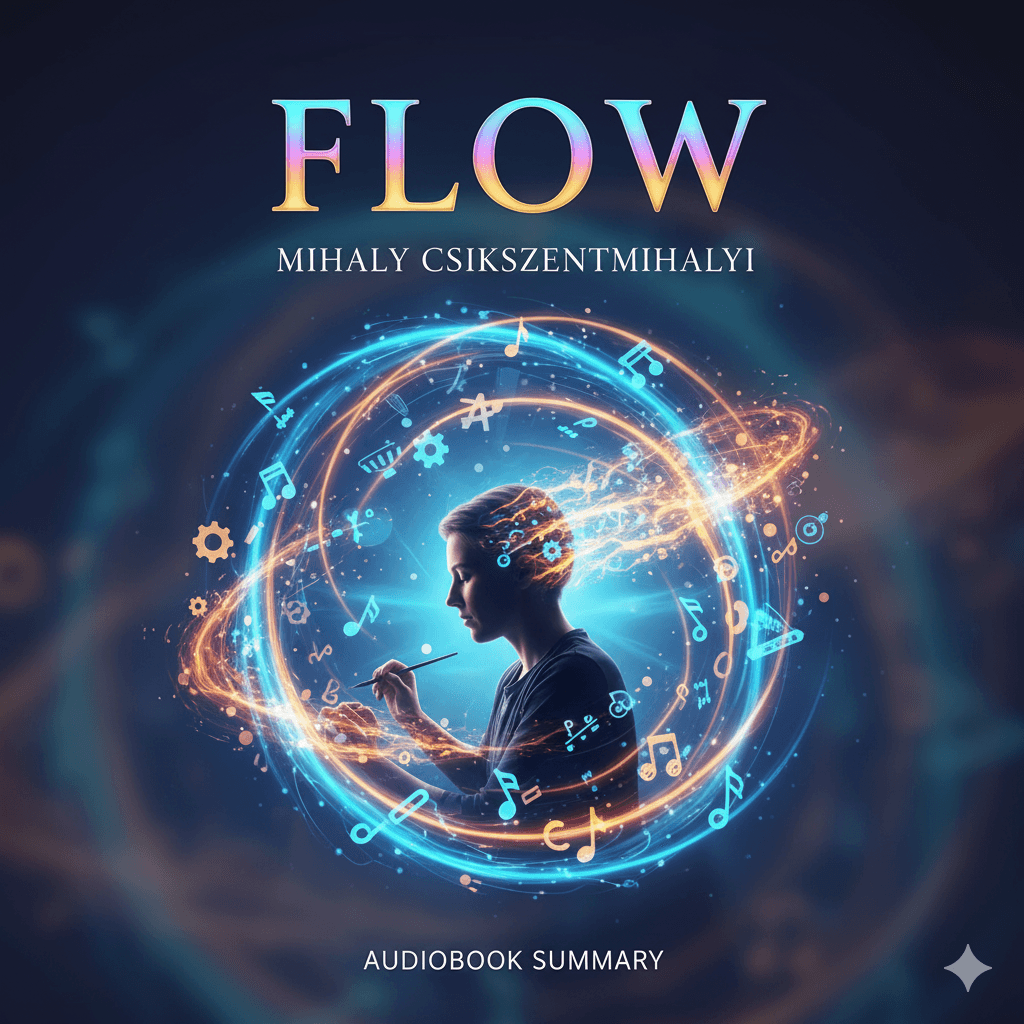
Why does a rewarding life feel so elusive? Psychologist Mihaly Csikszentmihalyi dedicated decades to this question. His research led him to the concept of “flow”—the state in which people are so involved in an activity that nothing else seems to matter; the experience itself is so enjoyable that people will do it even at great cost, for the sheer sake of doing it. Csikszentmihalyi’s work suggests a radically different path to a good life. It is not something that happens to us as a result of good fortune. Instead, it is a condition that we must create ourselves, through the disciplined ability to control our inner experience.
1. You’re Chasing Pleasure, But What You Really Want is Enjoyment
Csikszentmihalyi explains that pleasure is the feeling of contentment that arises from satisfying biological needs or social expectations. Eating when you’re hungry, resting after a long day, or enjoying a warm bath are all forms of pleasure. These experiences are passive; they restore a sense of order to our consciousness, but they do not lead to personal growth.
Enjoyment, on the other hand, is the feeling that comes from going beyond expectations to achieve something new or unexpected. Unlike pleasure, enjoyment is not passive. It requires an investment of our focused attention—what Csikszentmihalyi calls ‘psychic energy.’ Playing a close game of tennis that stretches one’s ability is enjoyable, as is reading a book that reveals things in a new light, as is having a conversation that leads us to express ideas we didn’t know we had.
This distinction is powerfully illustrated by the story of Signor Orsini, a Neapolitan antique dealer. When a wealthy tourist offered to pay his exorbitant asking price for a pair of statues without haggling, Signor Orsini refused the sale. He explained that without the “clash of wits involved in bargaining,” the transaction would be no fun at all. He valued the enjoyment of the process more than the pleasure of the profit.
Enjoyable events occur when a person has not only met some prior expectation or satisfied a need or a desire but also gone beyond what he or she has been programmed to do and achieved something unexpected, perhaps something even unimagined before.
This distinction is the very engine of personal growth. While a life built on fleeting pleasure depends on external circumstances, a life of enjoyment is actively constructed. It is through these moments of enjoyment that the self expands and becomes more complex.
2. The Surprising Reason You’re Happier at Work Than on Your Couch
Csikszentmihalyi’s research uncovered a central paradox of modern life: people report their most positive, “flow”-like experiences while on the job, yet they consistently say they would rather be doing something else.
The data is startling. Studies using the Experience Sampling Method, where individuals report their feelings at random moments throughout the day, revealed that people experience a state of flow (high challenges, high skills) 54% of the time at work, compared to only 18% of the time during leisure. Conversely, they report being in a state of apathy (low challenges, low skills) only 16% of the time at work, but a staggering 52% of the time in leisure.
Why this disconnect? The reason is that work often contains the built-in structure of a flow activity. Jobs typically have clear goals, provide immediate feedback, follow defined rules, and present escalating challenges. This structure organizes our attention for us, making deep involvement easier. Leisure, by contrast, is largely unstructured. Shaping it into an enjoyable, rewarding experience requires a much greater investment of personal effort and discipline.
Ironically, jobs are actually easier to enjoy than free time, because like flow activities they have built-in goals, feedback, rules, and challenges, all of which encourage one to become involved in one’s work, to concentrate and lose oneself in it. Free time, on the other hand, is unstructured, and requires much greater effort to be shaped into something that can be enjoyed.
We long for free time, yet when we get it, we often squander it on passive entertainment like television—an activity that provides some of the lowest levels of concentration and satisfaction—because it requires little effort to organize our consciousness.
3. Your Mind’s Default State Isn’t Peace—It’s Chaos
This paradox of being happier at work than at home makes perfect sense when we understand another of Csikszentmihalyi’s surprising discoveries: the mind’s default state isn’t peace, but chaos.
Contrary to what we might wish, the mind’s normal state, when left to its own devices, is one of disorder, or what Csikszentmihalyi calls “psychic entropy.” When we are not engaged by an external task or an internal discipline, our attention inevitably drifts. It is naturally attracted to our most pressing problems—real or imagined pains, recent grudges, or long-term frustrations. This tendency is the mind’s default setting.
This insight explains why so many of us turn to passive distractions. Activities like watching television are not so much a source of positive enjoyment as they are a low-effort way to structure consciousness and temporarily keep negative thoughts at bay. The predictable patterns on the screen provide just enough information to occupy our attention, preventing it from turning inward and dwelling on disorder.
Unless a person knows how to give order to his or her thoughts, attention will be attracted to whatever is most problematic at the moment: it will focus on some real or imaginary pain, on recent grudges or long-term frustrations. Entropy is the normal state of consciousness—a condition that is neither useful nor enjoyable.
True inner peace is not a state we fall into by default. It is something we must actively achieve by learning to order our own consciousness, rather than depending on external distractions to do it for us.
4. To Improve Your Life, Stop Trying to Change Your Circumstances
Perhaps the most profound and counterintuitive truth is a direct challenge to our culture’s deepest belief: that happiness is the result of improving external conditions like wealth, status, or power.
The ancient myth of King Midas serves as a timeless illustration of this folly. Midas believed immense wealth would guarantee happiness, so he was granted his wish that everything he touched would turn to gold. He soon discovered his tragic error when his food and drink turned to gold before he could consume them, and he died miserable amidst his priceless treasures. Modern research confirms this ancient wisdom. A study of some of the wealthiest people in America found that they reported being happy 77% of the time. While this is higher than the average person’s 62%, the difference is modest and suggests that even immense wealth provides only a small boost in overall happiness.
Csikszentmihalyi’s core argument is that the quality of our lives depends not on what happens to us, but on how we interpret and experience those events. The ultimate skill is to gain mastery over the contents of consciousness itself. His research is filled with powerful examples of individuals who transformed immense adversity into enjoyable and meaningful challenges. He studied prisoners in solitary confinement who maintained order in their minds by inventing complex mental games, like mapping the world on the cell floor and imagining themselves traveling across it, or by playing intricate games of chess against themselves in their heads.
Alexander Solzhenitsyn, describing how he survived the Gulag, provides a stunning example of this internal mastery:
Sometimes, when standing in a column of dejected prisoners…I felt such a rush of rhymes and images that I seemed to be wafted overhead…. At such moments I was both free and happy.
These individuals demonstrate that the power to create a good life is not an external prize to be won, but an internal skill to be cultivated. They prove that the most important battles for happiness are not fought in the world, but in the mind.
Conclusion: The Real Bottom Line
These four truths weave together into a powerful philosophy for a rewarding life. Because the mind’s default state is chaos, we cannot achieve happiness by accident; we must actively order our own consciousness. This order is created not through passive pleasure, but through active enjoyment, which is the engine of personal growth. We paradoxically find the conditions for enjoyment more often in the clear, structured challenges of work than in the formless void of leisure. This all leads to the ultimate conclusion: the quality of our lives is not determined by external circumstances, but by our internal ability to transform any situation into a controllable, flow-producing activity. The person who masters these skills—who can set their own goals, find challenges, and lose themselves in the pursuit of enjoyment—develops what Csikszentmihalyi calls an “autotelic self”: one that is driven by internal purpose and is the master of its own experience.
Instead of asking how you can get more from life, what if the real question is how you can find more enjoyment in the life you already have?