



5 Counter-Intuitive Ideas from ‘Blue Ocean Strategy’ That Will Change How You See Competition
Introduction: Escaping the Bloody Red Ocean
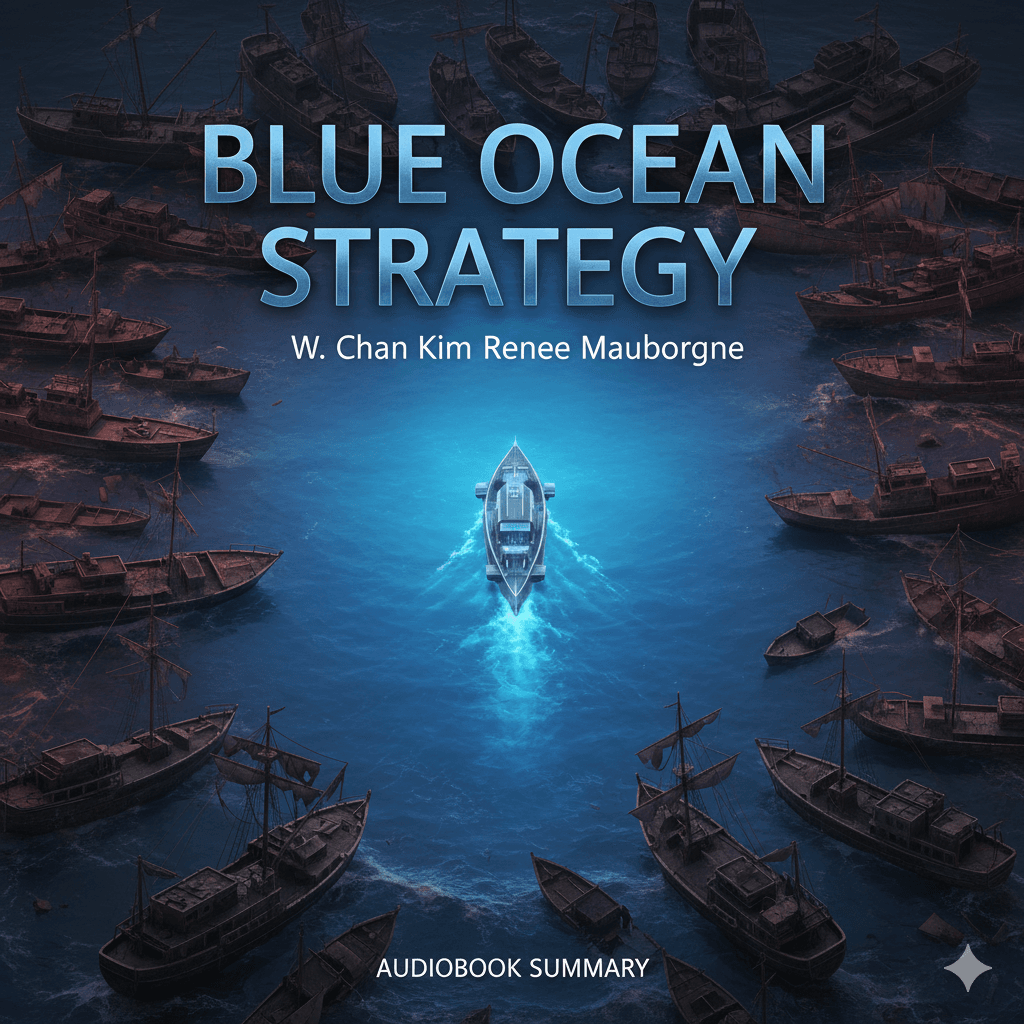
Modern business often feels like a shark tank. Competitors circle each other, fighting aggressively over a limited pool of customers. As the market space gets more crowded, this cutthroat competition turns the water bloody. This is the “red ocean”—a familiar world where rivals battle for dominance over existing demand, often leading to commoditized products, price wars, and shrinking profit margins.
But what if the goal wasn’t to fight harder, but to find open water? In their seminal book, Blue Ocean Strategy, W. Chan Kim and Renée Mauborgne present a powerful alternative: instead of battling rivals, create uncontested market space that makes the competition irrelevant. This is the “blue ocean.”
This article distills five of the most impactful and counter-intuitive takeaways from the book. These ideas challenge the foundational assumptions of traditional strategy and offer a new lens through which to view competition, growth, and innovation.
1. The Goal Isn’t to Beat the Competition—It’s to Make Them Irrelevant
The first and most fundamental shift proposed by Blue Ocean Strategy is a complete reorientation of your strategic mindset. Traditional, or “red ocean,” strategy is rooted in confronting an opponent. It accepts that industry boundaries are fixed and that the only way to succeed is to outperform rivals to grab a greater share of existing demand.
Blue ocean strategy argues that this approach is inherently limiting. Instead of focusing on the competition, you should focus on creating a leap in value for buyers that opens up new and uncontested market space. In a blue ocean, the rules of the game are waiting to be set, rendering competition irrelevant. This principle is captured perfectly by the authors:
“The only way to beat the competition is to stop trying to beat the competition.”
This is a profound departure from traditional business thinking, which is heavily influenced by its roots in military strategy—a world of “headquarters,” “front lines,” and fighting over a limited piece of land. Blue Ocean Strategy reminds us that unlike war, the market universe is not fixed. The real opportunity lies not in dividing up the existing world, but in creating new worlds.
Making the competition irrelevant requires a fundamental break from the value-cost trade-off that governs red oceans. This leads directly to the second principle: the simultaneous pursuit of differentiation and low cost.
2. Pursue Differentiation and Low Cost Simultaneously
Conventional business wisdom dictates a value-cost trade-off: a company can either create greater value for customers at a higher cost (differentiation) or create reasonable value at a lower cost (cost leadership). The idea of pursuing both at the same time is often seen as impossible.
Blue Ocean Strategy argues that this trade-off is a false choice. The cornerstone of the entire philosophy is Value Innovation, which is the simultaneous pursuit of differentiation and low cost. Value innovation is achieved only when companies align innovation with utility, price, and cost positions.
The book’s quintessential example is Cirque du Soleil. At a time when the traditional circus industry was in decline, Cirque du Soleil did not try to create a “better” circus. Instead, it reinvented it by challenging the industry’s core assumptions:
- It eliminated or reduced factors that the industry had long competed on. This included costly elements like star performers, animal shows, aisle concessions, and three-ring venues, all of which were expensive and losing their appeal.
- It raised or created new elements drawn from the world of theater. This included introducing a theme and storyline, artistic music and dance, multiple productions, and a more refined viewing environment.
By blending the artistic richness of theater with the fun of the circus, Cirque du Soleil created an entirely new genre of entertainment that made the choice between circus and theater a false one for its target audience. It appealed to a new group of customers—adults and corporate clients—who were willing to pay a premium price, while its cost structure was dramatically lower than that of traditional circuses. It didn’t have to choose between value and cost; it achieved both.
Cirque du Soleil redefined its market by looking beyond traditional circus-goers. This powerful idea of looking past your existing customer base is the third key to unlocking a blue ocean.
3. Look Beyond Your Existing Customers
Most companies are laser-focused on their existing customer base. Their strategic efforts revolve around retaining current customers and finding new ways to segment them, which often leads to deeper specialization and ever-smaller target markets.
To create a blue ocean, you must turn this logic on its head and look to the universe of “noncustomers.” The framework of the “Three Tiers of Noncustomers” provides a powerful lens for this. The first and closest tier consists of “soon-to-be” noncustomers—buyers on the edge of your market who minimally purchase an industry’s offering out of necessity, but are mentally checked out.
The British food chain Pret A Manger provides a perfect illustration. Before Pret, professionals in European city centers were first-tier noncustomers of the restaurant industry for lunch. They frequented restaurants out of necessity but were increasingly unhappy with the trade-offs: a sit-down meal was too slow and expensive for a daily habit, while traditional fast food wasn’t fresh or healthy. Many were on the verge of abandoning the market altogether by brown-bagging it or skipping lunch.
Pret A Manger looked at the powerful commonalities uniting these noncustomers: they all wanted a lunch that was fast, fresh, healthy, and reasonably priced. This insight led Pret to create a new market by offering restaurant-quality sandwiches made fresh daily, available with the speed of fast food. By aggregating the demand of these noncustomers, Pret unlocked a massive, previously untapped market of professionals who now had a perfect solution for their midday meal.
Identifying noncustomers is the first step, but reconstructing value for them requires a structured approach. This isn’t guesswork; it’s a systematic process guided by a powerful framework.
4. Use a Systematic Framework to Reconstruct Market Boundaries
Creating blue oceans is not a random stroke of genius or a matter of intuition. It is a systematic process that can be learned and replicated. A key tool for this is the Four Actions Framework, which challenges an industry’s strategic logic by asking four crucial questions:
- Which of the factors that the industry takes for granted should be eliminated?
- Which factors should be reduced well below the industry’s standard?
- Which factors should be raised well above the industry’s standard?
- Which factors should be created that the industry has never offered?
The Australian winemaker Casella Wines used this thinking to create [yellow tail]. The U.S. wine industry was intensely competitive, intimidating, and complex. By applying the four actions, Casella created a wine that was fun, simple, and accessible. They eliminated complex enological terminology on the bottle, reduced wine complexity (tannins, oak, aging), raised the ease of selection (offering only one red and one white initially), and created a sense of fun and adventure.
This framework is powerful because it simultaneously pushes companies to lower costs while lifting buyer value. As the authors state:
“Value innovation is created in the region where a company’s actions favorably affect both its cost structure and its value proposition to buyers. Cost savings are made by eliminating and reducing the factors an industry competes on. Buyer value is lifted by raising and creating elements the industry has never offered.”
The Four Actions Framework provides the analytical engine to create a new value curve. But how do you know if the resulting strategy is strong, clear, and easy to communicate? The final idea provides a simple but powerful litmus test.
5. A Great Strategy Should Pass the “Tagline Test”
How do you know if you’ve developed a true blue ocean strategy? The book offers a simple litmus test based on three complementary qualities: Focus, Divergence, and a Compelling Tagline.
- Focus: A blue ocean strategy doesn’t diffuse its efforts across all factors of competition. It emphasizes only a few key elements that deliver exceptional value.
- Divergence: The shape of a blue ocean strategy’s value curve on the strategy canvas stands apart from the rest of the industry. It doesn’t benchmark competitors; it redefines the playing field.
- Compelling Tagline: A good strategy should be so clear and unique that it can be summarized in a simple, authentic, and memorable tagline.
Southwest Airlines is a classic example. Its strategy focuses on friendly service, speed, and frequent point-to-point departures. It diverges by eliminating costly industry norms like assigned seating, lounges, and meals. Its compelling tagline could be: “The speed of a plane at the price of a car—whenever you need it.”
If a strategy is muddled, undifferentiated, and hard to communicate, it will fail this test. This simple check forces you to ask whether your strategy is truly a breakthrough or just a collection of competing tactics.
Conclusion: A Final Thought
The core message of Blue Ocean Strategy is both a challenge and an inspiration. It suggests that sustainable success comes not from battling competitors in a shrinking market, but from creating new market space where the rules have yet to be written. It’s about shifting your perspective from what is to what could be.
As you consider your own business or industry, ask yourself this final, powerful question:
Instead of asking how you can win in your current market, what would it take to make your competition completely irrelevant?